
Fueling Belgium’s Clean Energy Transition: The Hydrogen HiveMinds Ideathon
In the European energy transition, moving hydrogen research from the laboratory to national strategy requires strategic coordination and interdisciplinary collaboration
The Kreativdistrikt Innovation Engine
Designing an ideathon for PhD-level researchers requires far more than event logistics—it demands a tailored innovation methodology, dynamic energy management, and seamless execution. Kreativdistrikt engineered an end-to-end sprint architecture:
-
End-to-End Brand & Digital Infrastructure: We created the event identity, built a dedicated landing page, executed targeted digital outreach, and set up a custom Discord hub for cross-institutional collaboration.
-
Warm-up & Knowledge Curation: Before participants arrived in Brussels, Kreativdistrikt curated a comprehensive research repository linking EU, national, and regional roadmaps, supported by online technical webinars.


- The SFII Framework (Day 1): Curated by Arturo Ortega (Global Innovation Workshopper at Kreativdistrikt), our custom Signals | Future | Intent | Intervention (SFII) framework guided researchers from analyzing policy/tech signals to shaping plausible futures, defining desirable intents, and mapping concrete interventions.
-
Business Case & Storytelling Mastery (Day 2): We transitioned teams from ideation to business modeling, culminating in an intensive pitching workshop where Kreativdistrikt equipped researchers with storytelling tools to translate complex science into executive-level pitches.
-
Dragon’s Den & Industry Integration (Day 3): Kreativdistrikt facilitated a high-stakes “Dragon’s Den” pitch competition before an expert jury from WaterstofNet, Cluster Tweed, Bekaert, Fluxys, and FPS Economy.
-
High-Energy Facilitation: To prevent burnout during intense analytical work, Kreativdistrikt integrated custom mini-challenges—including an AirTag hunt under chairs, candy-jar guessing games, and a rock-paper-scissors tournament.
What We Delivered: Structured Outputs & Solutions
To ensure every team produced verifiable, investment-ready outputs, Kreativdistrikt structured the ideathon pipeline around six core deliverables:
Pre-Event Setup (Deliverable 1: Pre-Ideathon Pitch)
Before arriving on site, participating teams established their project context, selected their specific subtopic, and outlined baseline assumptions to ensure aligned goals from day one.
Ideathon Day 1 (Deliverables 2–5: SFII Pathway Framework)
During the first live sprint, teams worked through Kreativdistrikt’s signature framework, mapping out industry signals, modeling plausible future scenarios, articulating desirable intents, and designing concrete interventions.
Ideathon Days 2 & 3 (Deliverable 6: Business Case & Final Pitch)
In the final phase, teams converted their pathways into robust business models. Outputs included detailed feasibility analyses, economic impact projections, market adoption evaluations, scalability roadmaps, and a final 7-minute pitch presented to the expert jury.
Developing Groundbreaking Business Cases Across Three Pathways
Kreativdistrikt’s facilitators guided the eight multidisciplinary teams through three specialized innovation tracks, translating complex science into actionable case studies.
Pathway 1: Hydrogen as an Energy Carrier (System Integration) Focused on reshaping energy and mobility ecosystems, four teams developed solutions for system-level integration. Winning team BeeHydro designed a pathway integrating hydrogen technology into future waste-to-energy and biomass power plants to cut carbon emissions and maximize grid flexibility. Hush2O evaluated the economics of liquid hydrogen shipping by valorizing regasification energy across a Chile–Belgium supply chain. The Bumblebees targeted port grid congestion using reversible seawater electrolysis hubs, while HyNova introduced “FlexH2” to capture renewable energy surpluses for domestic supply.


Pathway 2: Hydrogen as an Industrial Feedstock (Demand Creation & Market Uptake) Centering on market adoption and early-stage industrial integration, two teams created mechanisms to stimulate hydrogen demand. Winning team H2Power developed an electrochemical brine valorization system for ammonia production, turning industrial waste streams into valuable fertilizer feedstocks. H2ERA proposed decentralized “Hospital Hydrogen Valleys” that install electrolyzers on-site at regional medical centers to utilize produced hydrogen, oxygen, and waste heat simultaneously.
Pathway 3: Hydrogen to Boost EU Competitiveness (Technological Leadership) Aiming to secure European technological leadership, two teams designed framework innovations to accelerate technology deployment. Winning team H2 O-ptimizers introduced “HyScore”—a standardized certification label combining origin and quality metrics to increase trust and liquidity in European hydrogen markets. BEIS (Belgian Evaluatory & Intervention System) engineered a platform concept connecting live data from pilot projects directly to industrial leaders and policymakers to accelerate regulatory learning cycles.
Real-World Impact
Kreativdistrikt’s methodology equipped 29 academic researchers with essential professional skills: multidisciplinary teamwork under pressure, system-level design thinking, business modeling, and executive storytelling. By taking care of all operations—from digital branding to expert curation and live orchestration—Kreativdistrikt empowered Ghent University and BE-HyFE to translate fundamental research into strategic assets for Belgium’s energy future.

PEOPLE IS WAITING TIGHT FOR YOUR EVENT TO BEGIN.
Book an appointment without pressure today and let’s start organizing your event today!
A word from our customer
“Kreativdistrikt was an outstanding partner, adapting to the evolving needs of the BE-HyFE project with professionalism and a truly uplifting team spirit. Their management—from the outreach campaign to the final evaluation steps—was impeccable.” — Marijke Mahieu, Project Coordinator at Ghent University & BE-HyFE Coordinator

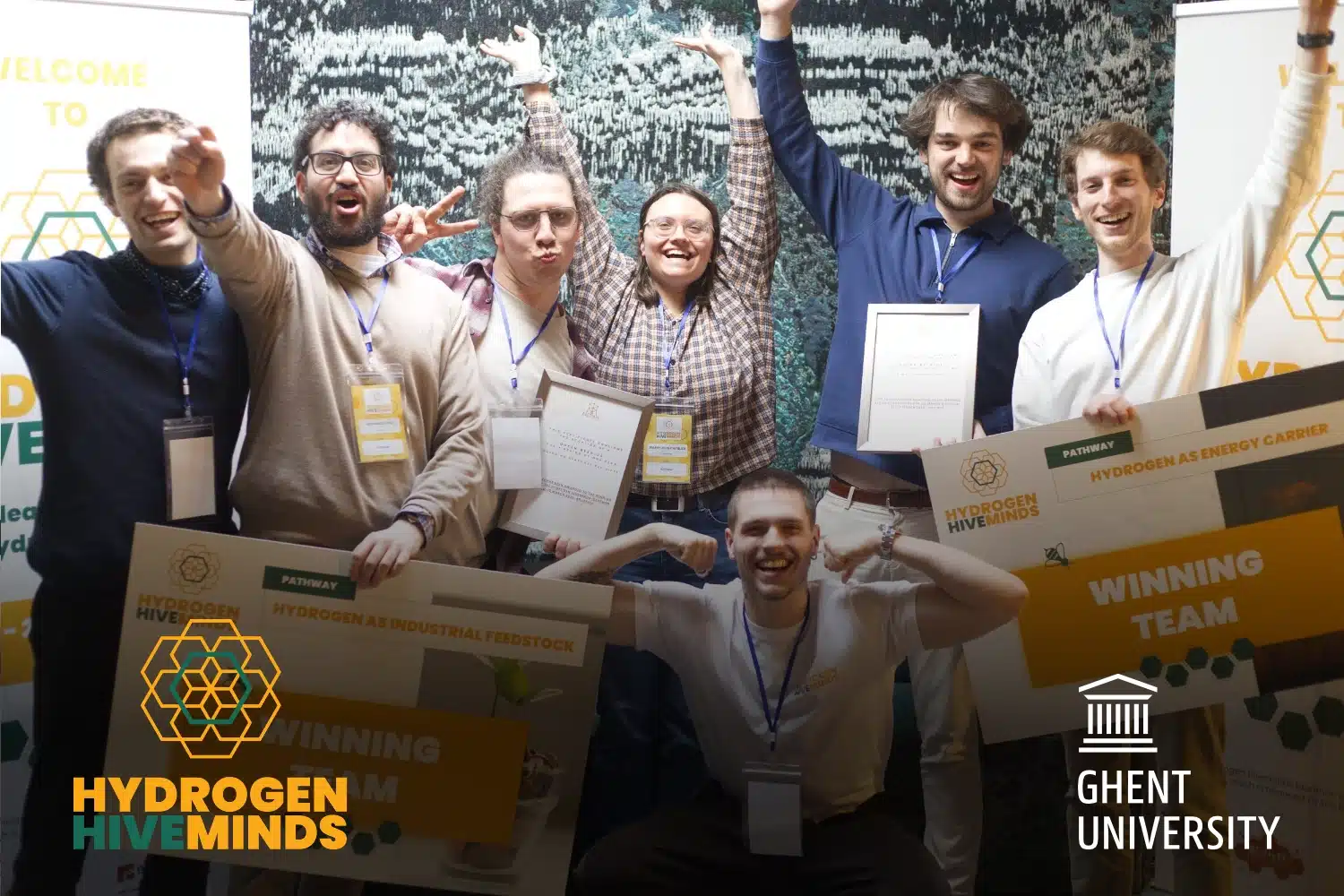
Celebrating the Winning HiveMinds
Beyond three days of intense strategic modeling, the event proved that solving complex energy challenges goes hand in hand with high-energy fun
Ghent University & BE-HyFE
Ghent University is one of Belgium’s premier academic institutions and a top European research hub, hosting over 50,000 students and 15,000 staff members guided by the motto Sapere Aude (“Dare to Think”). Through pioneering initiatives like BE-HyFE (funded by the Belgian Federal FPS Economy) and research networks like EnerGhentIC, Ghent University drives high-level expertise to solve complex sustainability challenges.
Get in touch with us today!
Book a time slot on our calendar and we will be happy to guide you all the way to a successful online hackathon!